
Stop Erosion Before It Reaches Your Property
Rockwall Installation in Marblehead for shorelines that are losing soil and need permanent protection against wave action
Marblehead Dredging & Marina Services installs rockwalls to stabilize waterfront property where wave action, runoff, and seasonal water level changes are cutting into the bank and threatening docks, lawns, and structures. You need rockwall installation when you see exposed roots along the shoreline, when sections of the bank have collapsed into the water, when soil washes away after storms, or when the distance between the water and your property line has noticeably decreased over several seasons. The company is an owner-operated contractor with more than forty years of marine construction experience and has been serving Lake Erie shoreline communities since 2013.
Erosion happens when waves repeatedly strike the shore, when fluctuating lake levels undercut the bank, and when rain or snowmelt carries soil downslope into the water. A rockwall blocks this process by placing large stones along the waterline to absorb wave energy, hold the soil in place, and create a stable boundary between land and water. The installation process includes grading the slope to the correct angle, placing a base layer of smaller stone for drainage, and stacking larger rocks to form a protective barrier that resists movement and lasts for decades.
If erosion is threatening your waterfront property or existing structures, contact Marblehead Dredging & Marina Services for a free estimate on rockwall installation and shoreline stabilization.
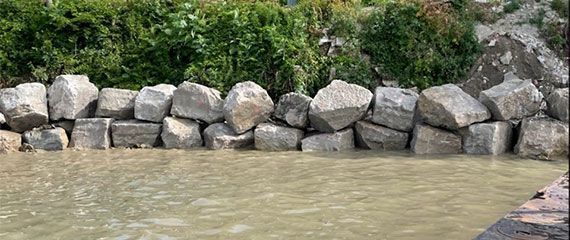
You will see heavy equipment position large stones along the waterline in layers that extend from below the typical water level to above the high-water mark, creating a sloped or vertical face that redirects wave energy back into the lake instead of allowing it to cut into the bank. The stones are placed tightly enough to prevent gaps but with enough variation to allow water to drain through the structure. Marblehead Dredging & Marina Services is fully licensed and insured and works with homeowners, marinas, and commercial waterfront properties to match rockwall design to site conditions and exposure.
After the rockwall is complete, you will notice that waves no longer reach the soil behind the stones, that the shoreline holds its position during storms, and that the area behind the wall remains dry and stable even when the lake level rises. The bank no longer crumbles or slumps after heavy rain, and the ground near docks and structures stays in place instead of washing away. The rockwall creates a defined edge between water and land, and the stones develop a weathered appearance over time as algae and mineral deposits form on the surface.
The size and extent of the rockwall depend on the height of your bank, the severity of wave action at your location, and the length of shoreline that needs protection. The company grades and prepares the site before placing stone and ensures that the foundation is stable enough to support the weight of the rockwall without settling. Installation does not include removing existing docks, relocating utilities, or planting vegetation, and those tasks are handled separately if required.
Questions About Rockwall Construction and Shoreline Protection
Waterfront property owners often ask what size stone is needed, how a rockwall handles changing lake levels, and how long the structure will last.
01
What size stone is used for rockwall installation?
The stones range from several inches to several feet in diameter, with larger rocks placed at the base and along the waterline where wave energy is strongest, and smaller stones used for fill and grading behind the face.
02
How does a rockwall handle fluctuating water levels on Lake Erie?
The wall is built to extend below the lowest expected water level and above the highest typical level, so it remains effective whether the lake is high or low, and the stone mass is heavy enough to resist movement during storms.
03
Why do some rockwalls last longer than others?
Rockwalls that are built with a stable base, proper drainage, and appropriately sized stone hold their position for decades, while walls built on loose soil or with undersized rocks may shift or settle after a few years.
04
When is the best time to install a rockwall in Marblehead?
Most installations are completed in late spring, summer, or early fall when water levels are predictable and equipment can access the shoreline without getting stuck in mud or dealing with ice.
05
How does a rockwall affect boat access?
The wall stabilizes the shoreline and prevents erosion that can undermine docks or create shallow areas near the shore, but it does not increase water depth or clear channels, and those issues are addressed with dredging if needed.
Marblehead Dredging & Marina Services provides free estimates for rockwall installation projects and will visit your property to review the shoreline, measure the area that needs protection, and recommend a design that fits your site and budget.
Our Contractors
Perform Rockwall Work in the Following Way:
Planning:
- Determine the Purpose of the Rockwall: Is it for aesthetic purposes, retaining soil, or defining boundaries?
- We measure the area and determine the desired height, length, and shape.
- Consider the type of rocks or stones that you want to use and their availability.
- We will work with you to obtain the needed permits or regulations for the construction of rockwalls.
Materials:
- Rocks or Stones: We will help you to choose rocks that are durable, weather-resistant, and suitable for your wall’s purpose.
- Mortar or Concrete Mix: We use a type that is appropriate for your project, considering factors like weather conditions and the size of the wall.
- Reinforcement Materials: Depending on the wall’s height and purpose, we may utilize steel rods, geogrids, or drainage materials.
Installation Process:
- Prepare the Foundation: We dig a trench along the planned wall’s path, ensuring that it is wide and deep enough to provide stability. We also remove any vegetation or debris.
- Lay the Base Layer: Our team will place a layer of crushed stone or gravel in the trench to provide drainage and stability.
- Start Stacking: We will place the rocks or stones, starting with the largest ones at the bottom. This ensures a level base. We will use mortar or concrete mix to secure the stones together.
- Maintain Stability: As we build the wall, we make sure to check the level, plumb, and alignment. Our staff does what is necessary to shape and fit the rocks together.
- Backfill and Compact: We then fill in the space behind the wall with crushed stone or gravel and compact it to provide additional support.
Repairing a Rockwall:
- Assess the Damage: Our staff can determine the cause and extent of the damage, whether due to erosion, shifting ground, or other factors. We will remove loose or damaged stones.
- Rebuild or Replace: Depending on the damage, we may need to rebuild a section of the wall or replace specific stones.
- Maintain consistency: We will match the existing style, pattern, and color as closely as possible to maintain its aesthetic appeal.